Thursday, August 10, 2017

Tax holiday for inclusive business models

Package two of the country’s tax reform initiatives will take a look at how to rationalize fiscal incentives. Certain factors that are being considered by our Finance department include the selection of industries to be promoted, the actual performance of registered entities vis-a-vis targets, and the period for availing of the incentives. It will be interesting to see how the government will continue to incentivize activities that result in positive social impact and inclusive growth. One of these activities currently qualified for fiscal incentives is the corporate Inclusive Business (IB) model.

IB is a private sector or business approach specifically directed at low-income communities or people who live at the Base of the Pyramid (BoP). A company adopting this approach customizes its business model to include low-income communities in its value chain as customers, suppliers, distributors, retailers, or employees. IBs provide more access to basic goods and services, and create opportunities for employment and livelihood to the marginalized sector in a sustainable, scalable, and commercially viable manner.

While it seems philanthropic, IBs are actually profitable investments. They also provide opportunities for large-scale businesses to realize reasonable profits from markets with significant growth potential, while making a positive social impact like reducing poverty and supporting community development. Hitting two birds with one stone as the old cliché goes.

IBs differ from Corporate Social Responsibility activities in that the latter are not conceptualized with commercial viability and profit in mind. However, both are effective ways of engaging the private sector to collaborate and partner with the low income communities, sharing in the responsibility of the government to bolster growth in all sectors, especially at the BoP.

Recognizing its potential, the Board of Investments (BoI) included IB in the 2014 Investments Priorities Plan (IPP), not as a preferred activity for investment eligible for incentives but as a key strategy for inclusive growth, and as a general policy for encouraging registered enterprises to adopt IB strategies and practices.

In the 2017 IPP, IB models finally got listed as one of the preferred activities. The IPP recognized business activities of medium and large enterprises in the agribusiness and tourism sectors which target micro and small enterprises (MSE) as part of their value chains. IB projects that are eligible for registration may qualify for BoI Pioneer status with entitlement to five years of income tax holiday.

To illustrate an IB model, let’s take an agribusiness enterprise that sources its raw materials (e.g. coffee beans, sugar, or cocoa) from low-income farmers, MSEs, or farmer’s cooperatives.

The enterprise may enter into a contract growing agreement with the farmers and may guarantee the purchase of their produce. It may provide technical assistance (e.g. trainings, seminars) or access to finance (e.g. loans, collateral) and farm inputs.

Further, the IPP enumerates the targets and the timetable for implementation of IB models.

Under the guidelines, within three years of commercial operations, at least 25% of the value of total cost of goods sold of qualified agribusiness enterprises and total cost of goods/services of qualified tourism enterprises must be sourced from registered and/or recognized MSEs (including cooperatives, or any organized entity duly recognized by a government body), as evidenced by a duly notarized contract. Moreover, there must be at least a 20% increase in the average income of individuals engaged from such MSEs from the baseline year to the third year of actual operations.

For qualified agribusiness enterprises, at least 300 farmers, fisherfolk, suppliers, and/or individual beneficiaries must be engaged, of which, at least 30% must be women. On the other hand, at least 25 direct jobs (regular employment) must be generated by qualified tourism enterprises for individuals in the identified database (e.g., DSWD Conditional Cash Transfer Graduates, DAR Agrarian Reform Beneficiaries, NCIP List, PWD, and others) of which, at least 30% must be women.

In addition, the enterprise must exhibit innovation in the business model through: (1) the provision of technical assistance/capacity building to the MSEs, farmers, fisherfolk, or employees that increases productivity and/or quality; or (2) facilitation of access to finance either directly or in partnership with a third party (i.e. provision of collateral by the company, direct lending through a subsidiary or third party-financing disbursed directly to the MSEs, farmers, fisherfolk, or employees or through the company).

Innovation in the business model may also be exhibited by agribusiness enterprises through the provision of inputs and/or technology to MSEs and/or individual farmers and fisherfolk.

Interested enterprises with agribusiness and tourism projects may opt to undertake IB models by submitting their duly notarized IB plans in the required BoI format upon application for registration.

A business strategy that incorporates the marginalized sectors of society may finally serve to break the shackles of poverty. As aptly expressed in the United Nations Report entitled, Creating Value for All: Strategies for Doing Business with the Poor (2008): “Inclusive business models build bridges between business and the poor for mutual benefit. The benefits for business go beyond immediate profits and higher income. For business, they include driving innovations, building markets, and strengthening supply chains. And for the poor, they include access to essential goods and services, higher productivity, sustainable earnings, and greater empowerment.”

With the promise that it holds, there is reason for the government to qualify IB models for fiscal incentives.

The views or opinions expressed in this article are solely those of the author and do not necessarily represent those of Isla Lipana & Co. The content is for general information purposes only, and should not be used as a substitute for specific advice.

Reynaldo E. Maniego III is a manager at the Tax Services Department of Isla Lipana & Co., the Philippine member firm of the PwC network.

+63 (2) 845-2728

reynaldo.e.maniego.iii@ph.pwc.com

Thursday, August 3, 2017

Waves of waivers

Some of the important lessons in life we learn from unpleasant experiences. Learning from the mistakes of our past keeps us from repeating them. Wisdom comes from accepting errors and exercising better judgment in the future.


The above statements hold true even in tax collection. In the past, the Bureau of Internal Revenue (BIR) lost assessment cases due to the issue of waivers on the statute of limitations for the assessment of deficiency taxes. It may have learned its lesson the hard way, but the Bureau has implemented improved measures stemming from its experience.

In a 2004 case (G.R. 162852 dated Dec. 16, 2004), the Supreme Court ruled that a waiver must strictly conform to the requirements set forth under the rules; otherwise, the waiver is invalid. At that time, the prevailing rule on the proper execution of a waiver of the statute of limitations was Revenue Memorandum Order (RMO) No. 20-1990 and Revenue Delegation Authority Order No. 5-2001.

In a subsequent case (G.R. No. 212825 dated Dec. 7, 2015), the Supreme Court provided an exception to the general rule on validity of waivers. The crux of the issue pertained to the issuance of defective waivers, arising from the fault of both the taxpayer and the BIR. The waivers were said to be executed by the taxpayer’s accountant without a notarized board authority to sign in behalf of the company. On the other hand, the BIR was considered to be careless in performing its functions when it did not ensure that the waiver was duly accomplished and signed by an authorized representative, among others.

In that case, the Supreme Court tolerated the BIR’s slip-ups for equitable reasons. The validity of the waiver in favor of the state was then upheld on the strength of the time-honored principle that taxes are the lifeblood of the government. In its decision, the Court said the BIR’s right to collect taxes should not be jeopardized merely because of the mistakes and lapses of its officers, especially in cases where the taxpayer was obviously in bad faith when it voluntarily executed the waivers and subsequently insisted on their invalidity by raising the very same defects it caused. Thus, the taxpayer was estopped from questioning the validity of the waivers.

As for the erring BIR officials, the Court suggested enforcing administrative liabilities for their failure to properly comply with the procedures.

In a more recent decision (G.R. No. 213943 dated March 22, 2017), the Supreme Court ruled that the three-year period to assess was not extended because all the waivers executed by the taxpayer were considered defective. What is significant to note is that the waivers were considered defective because the BIR failed to provide the third copies to the office accepting the waivers and these copies were merely attached to the docket of the case. Also, the revenue official who accepted the third waiver was not authorized to do so. In this case, the defects were solely due to the fault of the BIR.

While the BIR argued that the taxpayer was estopped from questioning the validity of the waivers, the Courts clarified that the BIR cannot shift the blame to the taxpayer for the defective waivers. The BIR cannot easily invoke the doctrine of estoppel to cover its failure to comply with the requirements for valid issuance of waivers. Having caused the defects, the BIR must bear the consequences. Considering that the waivers are defective, the assessment was considered issued beyond the three-year prescriptive period, and thus, void. Contrary to the 2015 case, the Court ruled in favor of the taxpayer here because it played no part in the waivers’ defects.

With the issuance of a new RMO last year, the question is -- Can taxpayers apply the above decisions of the Supreme Court for issues on waivers today?

On April 18, 2016, the BIR issued RMO No. 14-2016 which laid down new guidelines on the execution of waivers. According to the new RMO, compliance with the prescribed form is not mandatory. A taxpayer’s failure to follow the forms would not invalidate the executed waiver, for as long as (1) it is executed before the expiration period, and the date of execution is specifically provided in the waiver; (2) the waiver is signed by the taxpayer or duly appointed representative/responsible official; and (3) the expiry date of the period agreed upon to assess/collect the tax after the three-year period is indicated.

In addition, the new RMO provides that the taxpayer is charged with the burden of ensuring that the waivers are validly executed. The taxpayer must submit the duly executed waiver to the Commissioner of Internal Revenue or to the authorized revenue official (e.g., concerned revenue district officer or group supervisor as designated in the Letter of Authority or Memorandum of Assignment) who shall then indicate acceptance by signing the waiver. Moreover, the taxpayer must retain a copy of the accepted waivers.

Under the new RMO which seems to favor the BIR, it appears that upon execution of the waiver, taxpayers can no longer challenge its validity.

Thus, while there is a level of comfort in the decision of the Court that taxpayers should not be made to suffer for lapses of the BIR, this will only apply to waivers that have been executed prior to the effectivity of the new RMO. The BIR has learned from past mistakes. Here’s to hoping that taxpayers have learned from their own.

The views or opinions expressed in this article are solely those of the author and do not necessarily represent those of Isla Lipana & Co. The content is for general information purposes only, and should not be used as a substitute for specific advice.

Maria Jonas Yap is a Manager at the Tax Services Department of Isla Lipana & Co., the Philippine member firm of the PwC network.

+63 (2) 845-2728

maria.jonas.s.yap@ph.pwc.com


source:  Businessworld

Another look at the tax-exempt status of charitable institutions

Tax exemptions are often met with reservations and must withstand the strict scrutiny of revenue collectors. After all, taxes are the driving fuel that propels all programs and activities of the state. Absolving persons from their tax liabilities means reducing public funds and restraining the government from actualizing its goals.

Nevertheless, the legislative groundwork covering the tax exemption of religious and charitable institutions has long been established, even as early as the Commonwealth period. The rationale for the exemption springs from the benevolent neutrality approach premised on the ground that religious and charitable institutions are not engaged in profit-seeking undertakings; whatever gains derived by the organization redounds to charity. Hence, Section 30(E) of the National Internal Revenue Code (or simply, the Tax Code) is specifically couched to incorporate the rationale in these words: a non-stock corporation or association organized and operated exclusively for religious, charitable, scientific, athletic, or cultural purposes, or for the rehabilitation of veterans, wherein no part of its net income or asset shall belong to or inure to the benefit of any member, organizer, officer or any specific person shall be exempt from income tax.

In a recent decision (CTA Case No. 8912 dated July 25, 2017), the Court of Tax Appeals (CTA) emphasized that while our Tax Code provides exemptions for certain non-stock corporations from income tax, this incentive is not absolute. It reiterated that in order to enjoy immunity from taxation, the following requirements for exemption must continually be satisfied by the taxpayer: (a) The taxpayer must be a non-stock corporation or association; (b) Organized exclusively for charitable purposes; (c) Operated exclusively for such purposes; and (d) No part of its net income or asset shall belong to or inure to the benefit of any member, organizer, officer or any specific person.

In the foregoing case, the CTA ruled in favor of the BIR, declaring that while there was no sufficient evidence to prove that any income or asset inured to the benefit of any member or officer of the institution, the 10% preferential tax rate applicable to proprietary hospitals which are nonprofit (under Section 27(B) of the Tax Code) should be imposed since the taxpayer was not operated “exclusively” in charitable purposes. Although not barred from engaging in activities conducted for profit, any income the hospital derives from profit-oriented activities should not escape the reach of taxation. Thus, an organization with both non-profit and profit-generating activities may still enjoy its tax exempt status but only on income from not-for-profit activities. Any income generated from activities conducted for profit shall strictly be subject to income tax.

As basis, the CTA also cited previous cases (G.R. Nos. 195909 and 195960 dated September 26, 2012) where the Supreme Court extensively discussed the application of Section 30(E) of the Tax Code, as amended, and upheld the same decision.

For taxpayers, an important takeaway from this case is that in order to enjoy immunity from taxation, all of the requirements for the same must continually be satisfied by the taxpayer. Thus, being a non-stock and non-profit charitable institution does not automatically exempt an institution from paying taxes.

Generally, just relying on the specific tax-exemption provision of charitable institutions from our Tax Code, a non-stock, non-profit corporation is exempt from paying income taxes at first glance. In some instances, organizations tend to overlook the succeeding provision clearly stating that the exemption only applies to income from non-profit activities. Through this case, the CTA reiterated the prevailing tax position in the Philippines that income from profit-generating activity is taxable, regardless of the disposition of the income earned from such activities. Nonetheless, while this may be the case, an organization may still, at the same time, remain tax-exempt on income from its actual charitable activities. Therefore, it may be deduced that at the end of the day, the determining factor for taxability lies in whether an activity is for profit or not.

To be exempt from tax, the challenge is for charitable and religious organizations to have a better appreciation of the rationale behind their tax-exempt status. As a rule, taxation is the overarching principle and exemption is the exception; as such, the burden of proof rests upon the party claiming exemption to prove that it is, in fact, covered by the exemption so claimed.

The views or opinions expressed in this article are solely those of the author and do not necessarily represent those of Isla Lipana & Co. The content is for general information purposes only, and should not be used as a substitute for specific advice.

Nadine E. Chan is a manager at the Tax Services Department of Isla Lipana & Co., the Philippine member firm of the PwC network.

+63 (2) 845-2728

nadine.e.chan@ph.pwc.com


source:  Businessworld

Saturday, July 29, 2017

Get Real: Breaking down the tax reform package

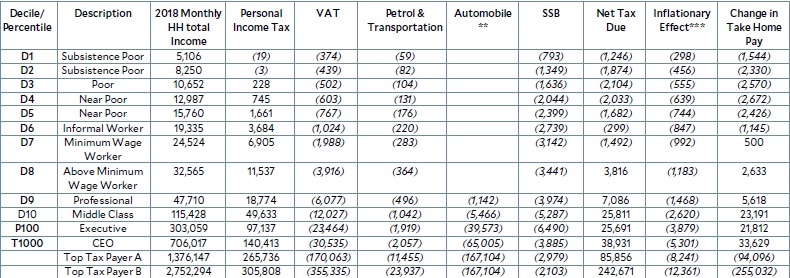
This table, from the Department of Finance, shows its estimates of the combined impact of the “TARA sa TRAIN” (Tax Administration Reform Act, Tax Reform for Acceleration and Inclusion) on Filipino households (hh).

The first column breaks down the households by decile (definition: each of 10 equal groups into which a population can be divided according to the distribution of values of a particular variable, which in this case is household income). Thus, you have the column listing from D1 to D10. The highest income decile (D10) is further broken down into the top 1 percent (P100), and even further into the top 0.1 percent (P1,000).  This further subdivision is done so we can see what the tax reform does to this elite class.

The second column describes the characteristics of each of the deciles. Note that the bottom 50 percent of income earners are either “Subsistence Poor,” “Poor” or “Near Poor.” Note that the  “Minimum Wage Worker” comes in the seventh decile, and  the highest (tenth) income decile is only where the “Middle Class” begins.

That decile is further broken down into “Executive,” those who belong to the top 1 percent, and still further into the top one-tenth of one percent are labeled “CEO.”
Now we come to the third column, which shows the 2018 monthly hh total income by decile. The DOF assumes that each hh has two income earners. The next seven columns give the impact of each of the tax measures in the tax reform package plus the effect of inflation.

The last column summarizes the final impact: the resulting change in take-home pay. Visually, without even looking at the details, the reader can see that the bottom 60 percent of income earners are negatively impacted by the package (the figures are in italics, and are parenthesized) as well as the top 0.1 percent. Those are the DOF estimates.

To make up for the minuses, there is a complicated and not yet worked out system of transfers that add up to P3,000 a year for the first five deciles and P1,500 for the next two (up to the seventh decile). BUT: This is relief that lasts only four years. WHY ONLY FOUR YEARS? No one who has critiqued my stand has answered.


Source: DOF staff estimates using the preliminary Family Income and Expenditure Survey- Labor Force Survey 2015
Notes: Each household has about two income earners

*Total household income includes compensation income, income from entrepreneurial activities (i.e. businesses) and other sources of income (i.e. cash transfers)

**Automobile excise tax impact was computed using 2016 prices, assuming 5 years of amortization

***The inflationary effect was computed as a function of income, marginal propensity to consume (MPC), and estimates on the price effect of the increased oil excise on the price of food

source:  Philippine Daily Inquirer By:

Wednesday, July 19, 2017

What the legislature grants, it can take away

While queuing for more than an hour just to catch a ride home, I noticed commuters in front of me giggling while staring at their smartphones with earphones on. I subtly leaned in to find out what was stirring their interest. On the screen, I saw the familiar faces of Korean actors of a prime time soap opera. I realized that the benefit of foreign telenovelas among Filipinos is that it helps to keep them calm and entertained, especially city commuters who endure hours of standing in line.

With the robust expansion of foreign influences into mainstream media as seen in drama series, K-pop songs and matinee idols (i.e., boy bands), we also see the enhancement of foreign relations between the Philippines, South Korea and the global community at large.

On the economic side, the Philippine government has incessantly endeavored to introduce measures that will increase foreign investment such as providing various fiscal and non-fiscal incentives to foreign investors. One example of these incentives is that specifically provided to regional operating headquarters (ROHQs).

As defined, an ROHQ is a resident foreign business entity which is allowed to derive income in the Philippines by performing qualifying services to its affiliates, subsidiaries or branches in the Philippines, in the Asia-Pacific region and in other foreign markets. Its operations are limited in the sense that it is merely allowed to perform the qualifying services enumerated in the Omnibus Investments Code of 1987, and only for its affiliates. Violation of these rules may result in the revocation of the ROHQ’s license or registration, and effectively, its tax exemptions and incentives.

WHAT EXACTLY ARE THE INCENTIVES PROVIDED BY OUR GOVERNMENT TO THESE ROHQS?
Generally, resident foreign corporations are subject to the 30% corporate income tax. However, as provided in the Tax Code, an ROHQ is liable to income tax at the special rate of 10% based on its taxable income. In addition, an ROHQ is also exempted from the payment of all kinds of local taxes, fees, or charges imposed by the local government, except real property tax on land improvements and equipment. Likewise, it is entitled to a tax and duty-free importation of equipment and materials used for training and conferences.

Moreover, several incentives are also given to expatriate employees of an ROHQ. These include the grant of a multiple entry visa for the expatriate employee including his spouse and unmarried children below the age of 21, tax and duty-free importation of personal and household effects, and travel tax exemption. Most importantly, a preferential tax rate of 15% applies on the salaries, annuities, and all other compensation of expatriates occupying managerial and technical positions exclusively working for the ROHQ and earning a gross annual taxable compensation of at least P975,000. The same treatment applies to Filipinos employed and occupying the same position as those aliens employed by the ROHQ.

Given the huge tax savings and various non-pecuniary benefits profusely provided by the Philippine government, many foreign corporations opted to establish their ROHQs in the Philippines resulting in a boost to foreign investment. This further translated to a rise in job opportunities for highly skilled workers, enticement for highly desirable employees, and a reduction in the risk of brain drain, among others.

A significant change in the incentives provided to ROHQs is being proposed in the Tax Reform for Acceleration and Inclusion (TRAIN) Bill passed by the House on May 31. Section 7 of the TRAIN Bill amends Section 25 of the National Internal Revenue Code of 1997. Specifically, the Bill deletes the 15% preferential tax rate provided to ROHQ employees occupying managerial and technical positions.

WHAT DOES THE REMOVAL OF THIS PREFERENTIAL TAX RATE MEAN FOR ROHQ EMPLOYEES?
Evidently, the ROHQ employees’ taxable income will then be subject to the normal graduated income tax rates of 0% to 35% applicable to all employees, as proposed by the TRAIN Bill. Those previously enjoying the preferential income tax rate of 15%, given the gross annual income of at least P975,000, will most likely qualify for the 30% to 35% income tax rates. The effective tax rate would, of course, be lower than 30% to 35%, but it would definitely be more than the current 15% rate. Consequently, this would result in reduced take-home pay for such employees if there is no augmentation in their gross compensation.

It is also worth noting that the TRAIN Bill is just the first part of the Tax Reform Program of the Philippine government. The second package intends to review and amend the income taxes on corporations, among others. Thus, it is possible that the 10% special income tax rate provided to ROHQs may also be amended or totally removed.

Some may argue that these reforms will produce unfavorable outcomes for the Philippine economy. Nonetheless, we must always bear in mind that the power of taxation is solely vested in the legislature. It is only Congress, as delegates of the people, which has the inherent power not only to select the subjects of taxation but to grant incentives and exemptions. Given the power to grant, it also has the inherent power to take away. We just have to trust that this move is consistent with the goal of the Tax Reform Program of achieving “efficiency, equity and simplicity” in our tax system and eventually benefit the entire population in the near future.

The views or opinions presented in this article are solely those of the author and do not necessarily represent those of Isla Lipana & Co. The firm will not accept any liability arising from the article.

Abigael Demdam is a senior consultant at the Tax Services Department of Isla Lipana & Co., the Philippine member firm of the PwC network. Readers may call +63 (2) 845-2728 or e-mail the author at abigael.demdam@ph.pwc.com for questions or feedback.


source:  Businessworld

Sunday, July 16, 2017

No deal

The tax evasion proceedings against homegrown cigarette manufacturer Mighty Corp. is proving to be a test case in the Duterte administration’s campaign to punish corporate offenders.

It has, we heard, already caused a rift between lawmakers and President Duterte’s officials.

Mighty’s offer to settle was finally made public last week by the Department of Finance, which is reviewing the proposal sent to its attached unit, the Bureau of Internal Revenue, which is the lead agency in the cigarette firm’s case.

In a July 10 letter to Internal Revenue Commissioner Caesar R. Dulay, Mighty president Oscar Barrientos indicated that the firm was willing to “settle all such excise and tax issues and respectfully offer as settlement of the company’s shareholders’ and its officers’ liability … the total sum of P25 billion.”

The BIR has filed three tax-evasion cases against Mighty at the Department of Justice for its alleged use of fake tax stamps in order to dodge payment of excise taxes. It estimated the unpaid taxes at P37.88 billion.

Barrientos said the settlement sum would be funded by an interim loan from the unit of Japan Tobacco Inc. (JTI) in the Philippines and the sale by Mighty and its affiliates of its manufacturing and distribution business and assets, along with the associated intellectual property rights, including those owned by the company Wong Chu King Holdings Inc., and other affiliates to JTI “for a total purchase price of P45 billion, exclusive of VAT.” In effect, Mighty will cease operations after concluding its deal with JTI.

Barrientos indicated that Mighty would pay P3.5 billion in deficiency excise taxes on its cigarette products that are now the subject of the three tax cases pending at the DOJ. Mighty would also remit P21.5 billion “representing the liabilities of the company and its shareholders, as well as the company officers for all internal revenue taxes, including income tax from 2010 to 2016 and the tax period up to the closing of the proposed transaction with JTI, and all transaction taxes related to the agreement with JTI.”

He said that the initial payment of P3.5 billion would be paid by Mighty on or before July 20, and that a binding memorandum of agreement in relation to the proposed transaction with JTI would be concluded before that date. The balance is to be paid upon or after the sale of Mighty to JTI.

After all these, Mighty wants the BIR to issue to the company and its shareholders and officers “the relevant certificate of availment of compromise, a final tax assessment for all the company’s excise and other tax issues described above, and relevant tax clearances to the company, its shareholders and officers,” Barrientos said.

Finance Secretary Carlos Dominguez III is correct to make it clear that any settlement offer by Mighty for its tax deficiencies should be separate from the criminal charges that might be filed in court by the BIR against it. Dominguez’s position that criminal liability should be left out of any settlement with Mighty is the alleged cause of disagreement between the cigarette firm and its backers in Congress on one hand, and the President’s economic team on the other.

Clearing Mighty of criminal liability under the proposed settlement will certainly weaken the government’s resolve to weed out unscrupulous businessmen who have been depriving the people of vital public services through nonpayment of taxes. Settlement with a company that underpaid its taxes without intending to—for example, due to a disparity in valuations—should be agreeable. But this should not be so for a company that deliberately evaded the payment of taxes by resorting to criminal acts like the use of fake tax stamps.

And just as a reminder, Section 263 of the Tax Code states that any person found in possession of locally manufactured articles subject to excise tax, the tax on which has not been paid in accordance with the law, shall be punished with a fine of not less than 10 times the amount of excise tax due, as well as imprisonment.

source:  Philippine Daily Inquirer

Saturday, July 8, 2017

A Letter Notice cannot substitute for a Letter of Authority

Taxation is the lifeblood of the government. Through the collected taxes, the government is able to fund the increasing need of its people for infrastructure, education, health, etc. The Bureau of Internal Revenue (BIR) is the Philippine government’s largest revenue collecting arm. For this year alone, the Bureau was assigned a P1.8 trillion tax collection target.

Throughout the years, the BIR has implemented various programs to improve its tax collection efforts. In 2003, it issued Revenue Memorandum Order (RMO) Nos. 30-2003 and 42-2003 which provided policies and guidelines to detect tax leaks by matching data from the BIR’s Integrated Tax System (ITS) and data from third party resources. Discrepancies generated through these matchings were used to unearth what could potentially be undeclared sales and/or over-claimed purchases by various taxpayers.

This “no-contact-audit approach” enables the BIR to use computerized matching to compare data from records or various returns filed by a taxpayer against those gathered from its suppliers or customers, and even those reported to other agencies, particularly the Bureau of Customs. Taxpayers with noted discrepancies are then informed of the findings through the issuance of a Letter Notice (LN) by the BIR. Consequently, such taxpayers are given 120 days to reconcile the inconsistencies; otherwise, deficiency taxes will be assessed.

In one of its recent decisions, the Supreme Court (SC) held that the absence of a Letter of Authority (LOA), makes the assessment unauthorized and thus, void. This is despite the prior issuance of an LN. According to the court, the BIR’s failure to issue an LOA constituted a violation of due process and was considered fatal to the tax audit.

The SC differentiated an LOA from an LN, noting that LNs only serve as notice of any discrepancy to the taxpayers and is not in any way a substitute for an LOA which grants authority to the revenue officers to examine the books of the taxpayers. The LN operates similarly to a Notice of Informal Conference, an erstwhile requirement which was removed from the BIR’s tax audit process when the Bureau issued its revised regulations for tax audits back in 2013.

The SC stressed that the BIR must issue an LOA prior to issuing a Preliminary Assessment Notice (PAN), a Final/Formal Assessment Notice (FAN), or a Final Decision on Disputed Assessment (FDDA) to the taxpayer; otherwise, the assessment is rendered void for lack of due process.

This decision overturns the earlier ruling of the Court of Tax Appeals (CTA) en banc which held that the LN in essence, can serve as proof of the revenue officer’s authority to examine the books of the taxpayer. The court pointed out that the taxpayer can no longer question the validity of the tax assessment on the ground of lack of an LOA since the BIR had provided the requisite legal and factual bases of the deficiency tax being assessed. In the higher interest of justice, the SC considered the absence of the LOA as fatal to the case, underscoring the importance of due process.

The SC’s decision to reverse the CTA ruling thereby effectively negates RMO No. 55-2010, which was issued by the BIR based on the earlier CTA ruling. As it is, the BIR has yet to issue guidelines on this recent decision by the SC.

Due process is a basic right guaranteed to all persons under the Philippine Constitution. It is an elementary rule that no person shall be deprived of property without due process of law. To boost taxpayers’ compliance with the tax laws and regulations, the government, through its tax authorities, must continually build trust and confidence among taxpayers and in the society in general.

The pronouncement of the SC brings to light, once again, the significance of due process in taxation. While it is imperative for the tax authorities to generate revenues through exaction of taxes, the government’s power to tax must be exercised with justice. This can only be achieved when collection of taxes exercised through programs are implemented with reasonable requirements and within the bounds of the law.

However steep the BIR’s collection target is, it must be reached only through acts that are within the bounds of the Bureau’s authority.

The views or opinions presented in this article are solely those of the author and do not necessarily represent those of Isla Lipana & Co. The firm will not accept any liability arising from the article.

Kathrine Joy S. Capales is an Assistant Manager at the Tax Services Department of Isla Lipana & Co., the Philippine member firm of the PwC network.

+63 (2) 845-2728

kathrine.joy.capales@ph.pwc.com


source:  Businessworld